The Importance of Consulting in System Standardization
In today’s businesses , system standardization has become one of the key secrets to success. Different teams and departments working in their own ways can lead to lost productivity and communication breakdowns in the long run . Therefore, it is critical for companies to unify their IT infrastructure and business processes within a defined framework. So, what exactly does standardizing systems bring to businesses, and what is the role of consulting services in this process ? Below, we will examine this issue under four main headings:
1. Benefits of System Standardization for Businesses
2. The Role of Consulting Services in the Standardization Process
3. Standardization Approaches of Global Technology Giants
4. Standardization in IT Infrastructure with OrbisEngine Technology Consulting
1. Benefits of System Standardization for Businesses
What is system standardization? Simply put, system standardization is when a business harmonizes all its IT processes and infrastructure around specific rules and standards. In other words, it means doing things the same way every time within the company . This ensures a common language between departments, seamless integration of systems and software , and everyone working together as if they’re on the same page .
Why is it important? A standardized system runs smoothly , like a well-oiled machine . Below, we have summarized the key benefits that system standardization offers to businesses :
- Efficiency: Repeatable and defined processes shorten team learning times and increase the speed of work . Workflows are accelerated because everyone knows best practices, thus saving costs . Different units trying to solve the same problem with different tools, or each team applying “their own method,” slows down operations and leads to wasted resources. Establishing a standard approach prevents such repetition and reduces costs by speeding up operations . [dragon1.com]
- Security: In a standardized infrastructure, all systems are subject to common security policies . This reduces vulnerabilities and creates a consistent line of defense against threats. An integrated security structure, instead of scattered, incompatible systems, significantly reduces cyber risks. For example, a global study by IBM and Palo Alto Networks revealed that companies use an average of 83 separate security tools from 29 different vendors , and this fragmented structure makes management difficult and increases risks. A standardized security architecture prevents such unnecessary complexity, providing stronger and more proactive protection against attacks . [newsroom.ibm.com]
- Compliance: Inconsistent systems can become a nightmare in legal compliance processes. However, a company where processes and documentation are conducted according to standards will more easily comply with international standards like ISO or industry regulations . For example, if all units of your company adhere to established protocols, it will be much easier to provide the required evidence during audits . Standardization makes your operations transparent and traceable; thus, regulatory compliance becomes effortless and the risk of potential sanctions is minimized .
- Sustainability: Standardized systems mean a more sustainable and scalable IT infrastructure in the long run . Technical debt (reliance on outdated technology) is reduced, and transitions to new technologies or system updates are less problematic. Standardization also generally increases resource and energy efficiency . For example, using uniform platforms and consolidated servers contributes to environmental sustainability by reducing unnecessary hardware and energy consumption. Furthermore, a less diverse and more cohesive IT landscape means less complexity, higher system availability, and lower risk. This makes your company’s technological infrastructure future-proof and resilient in the long term . [dragon1.com]
2. The Role of Consulting Services in the Standardization Process
System standardization, while very beneficial, requires a certain level of expertise and experience to implement . Within a business , the question of “Where should we start?” can sometimes be the biggest obstacle in initiating the process. This is where consulting services come in.
Seeking consultancy facilitates the standardization journey. Experienced consultants bring best practice examples and expertise from various sectors to your company. First, they analyze your current situation to identify areas needing improvement. Then, they create a customized roadmap and plan the transition to standards step by step. This allows your internal teams to continue their daily workloads while progressing towards their transformation goals.
Several key contributions of consulting services:
- External Perspective: Teams within a company sometimes become so accustomed to their own processes that it can be difficult to spot problems. Consultants, however, evaluate your systems from an independent perspective , identifying issues that might otherwise go unnoticed.
- Expert Guidance: Our expert consultants are knowledgeable about international standards (ISO, ITIL, etc.). They will determine which standards are most suitable for your business and outline the necessary steps to comply with them.
- Speed and Efficiency: A proper roadmap prevents unnecessary trial and error, saving time and money . Seeking consultancy services increases your return on investment (ROI) in the long run , as it helps you get things right the first time.
- Change Management: Transitioning to standardization means change for employees. Consultants support you in managing this change, training your team on new processes, and adapting them . This way, you can accelerate change while reducing internal resistance.
In conclusion, seeking consulting services for system standardization is like embarking on a journey with a skilled guide . This allows your company to navigate challenging transformation processes more smoothly, much like overcoming rough terrain with an experienced mentor . It both enhances your global competitiveness and reduces the workload for your internal teams.
3. Examples of Standardization from Global Technology Giants
The world’s leading technology companies provide prime examples of the power of standardization . These giants not only implement standardization in their own operations but also lead the way by offering standardized solutions to their customers. Here are some of the approaches taken by these companies:
- Microsoft & IBM: Leading companies in enterprise technology have long been pioneers in setting and disseminating best standards . Guidelines like Microsoft’s Azure Well-Architected Framework and IBM’s global consulting units are designed to help businesses standardize their IT infrastructure . As a result, countless companies worldwide are implementing frameworks like ITIL and COBIT , leading to more streamlined and auditable processes .
- Fortinet & Palo Alto Networks: These two cybersecurity companies highlight the importance of integrated and standardized security platforms . Recent research shows that many businesses use numerous different tools to ensure security, leading to confusion in management. Fortinet and Palo Alto Networks offer their customers “all-in-one” security platforms, consolidating scattered security tools and bringing them together under a single standard . Such an integrated approach enables faster response to threats and reduces security costs. For example, according to a joint report by IBM and Palo Alto Networks, companies that standardize their security systems with a platform approach can shorten the time it takes to detect and contain cyber incidents by an average of 70-80 days . This shows that standardization strengthens security and increases operational efficiency. [newsroom.ibm.com] [ibm.com] , [newsroom.ibm.com]
In short, global companies are telling us this: Standardization is not a choice, it’s a necessity. Whether you’re a tech giant or an SME, establishing a consistent and standardized system is a cornerstone of long-term success and innovation .
4. Standardize Your IT Infrastructure with OrbisEngine Technology
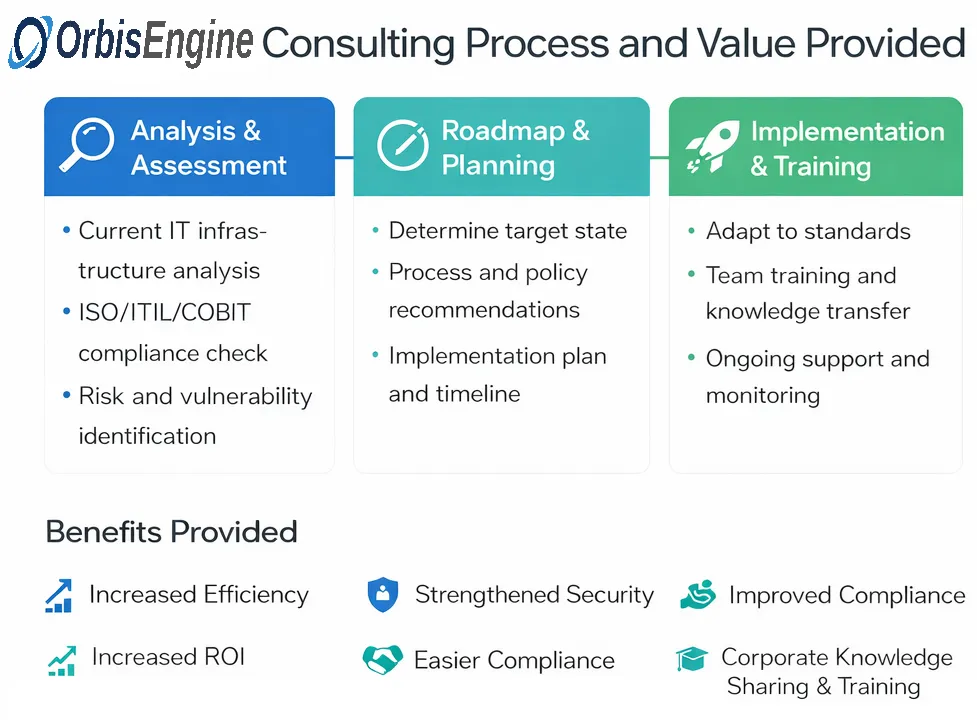
Ultimately, to move from theory to practice in system standardization , you need a reliable business partner. This is where OrbisEngine Technology Solutions comes in, offering consulting services to businesses . OrbisEngine’s expert team conducts a detailed analysis of your IT infrastructure and business processes , determining the standardization steps you need. Through this comprehensive analysis, we clarify your current situation and define your “target” point.
OrbisEngine is proficient in international standards such as ISO 27001, ISO 22301, ISO 20000, ISO 38500, as well as best practice frameworks like ITIL & COBIT . During our consulting process:
- Standards Compliance Analysis: We evaluate the status of your current IT infrastructure and processes against the standards and frameworks listed above. We identify your strengths and weaknesses, risk points, and opportunities for improvement .
- Roadmap and Implementation: Following the analysis, we prepare a customized roadmap (action plan) for your company . This plan includes concrete steps to be taken for compliance with standards, necessary policy and documentation adjustments, and technology solutions. The OrbisEngine consulting team also supports you throughout the implementation process of this plan, ensuring a smooth transition to change .
- Training and Support: For standardization to be lasting, the training and adaptation of your teams are critical. OrbisEngine helps your personnel adapt quickly to new systems and processes by providing the necessary training.
As a result of all these efforts, your IT processes become measurable, auditable, and aligned with corporate maturity . In other words, with OrbisEngine consulting support, your company’s technological infrastructure achieves the following gains:
- High efficiency and savings (optimum resource utilization),
- Enhanced security (cybersecurity measures compliant with standards),
- Ease of regulatory and compliance (processes ready for ISO and other standards),
- Sustainability (a robust, scalable, and manageable IT infrastructure in the long term).
Remember: standardization is not a destination, but an ongoing journey. Navigating this path with the right guidance and expertise will elevate both your business results and your technology infrastructure to a whole new level. At OrbisEngine , we are ready to work with you on this journey and help you achieve excellence in your IT infrastructure .