


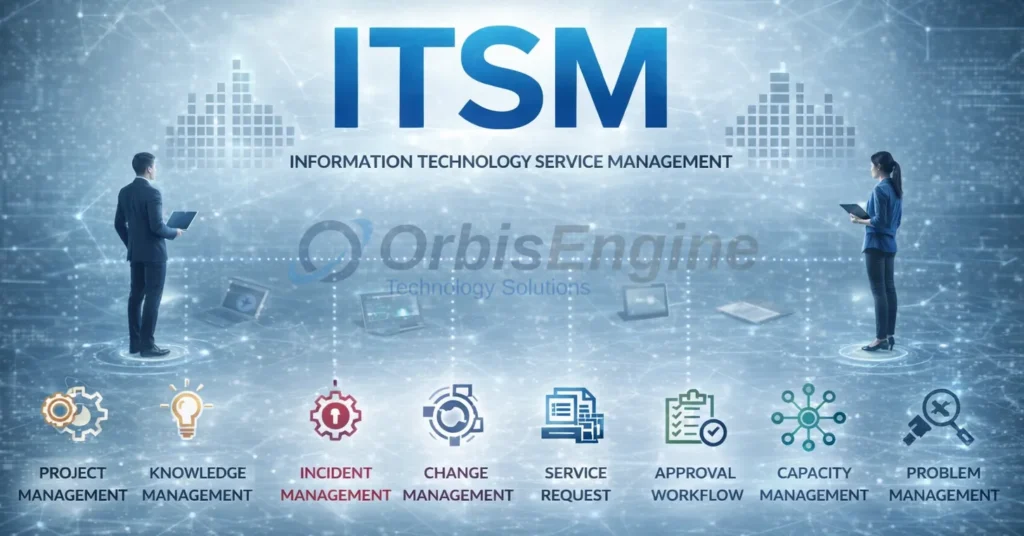
This guide covers the fundamentals of ITSM, why it should be used in your business, implementation standards, implementation strategy, and the benefits you will gain; it also includes how OrbisEngine Technology can support you in terms of improving your IT management.
With rapidly evolving technology today, organizations rely heavily on IT infrastructure to deliver quality services and support business operations. However, managing and maintaining complex IT systems is becoming a challenging task, especially as technology constantly evolves and becomes increasingly crucial to business success. This is where IT Service Management (ITSM) comes in. It’s a set of practices and processes designed to plan, deliver, and manage IT services that meet the needs of customers and stakeholders. By implementing effective ITSM practices, organizations can improve service quality, reduce costs, and increase customer satisfaction, ultimately leading to business success and competitiveness. But what exactly is ITSM, and why is it so important for organizations?
“Don’t think IT Service Management (ITSM) as just software! ITSM encompasses managing your business’s IT services according to defined standards. Businesses that effectively implement ITSM can experience a significant leap in their production growth and quality approach tailored to customer preferences, ultimately leading to increased business excellence and competitiveness.”
This guide covers ITSM framework fundamentals, common topics and maintenance strategies—plus how OrbisEngine Technology can support your infrastructure journey.
What is an ITSM framework?
An ITSM (IT Service Management) framework is a set of guidelines, best practices, and processes that help organizations plan, deliver, and manage IT services to meet the needs of their customers and stakeholders. It provides a structured approach to ITSM, enabling organizations to:
- Define and deliver IT services that meet business needs
- Manage IT services efficiently and effectively
- Continuously improve IT service quality
Most Common ITSM frameworks
- ITIL → ITIL has five key stages: service strategy, design, transition, operation, and improvement. ITIL
- ISO/IEC 20000 – 9000 → It was created based on ITIL best practices, but it also works with other frameworks like MOF and COBIT. ISO
- COBIT → It provides best practices for controlling and managing IT services within an organization. COBIT
- Capability Maturity Model Integration (CMMI) → It measures how mature and optimized an organization’s processes are. CMMI
- Six Sigma → It focuses on reducing variability in processes to improve quality. SixSigma
- Kaizen → It encourages businesses to constantly look for ways to improve every part of their organization, from the IT service desk to sales operations. Kaizen
- Microsoft Operations Framework (MOF) → It covers the entire lifecycle of IT services and aims to improve efficiency and reliability. MS MOF
How to implement ITSM in your processes
1. Assess Your Current State Assess your current IT service management practices, processes, and tools to identify areas for improvement. This includes evaluating your incident, problem, and change management processes, as well as your service catalog, service level agreements (SLAs), and key performance indicators (KPIs).
2. Define Your ITSM Strategy Define your ITSM strategy and goals, aligning them with your organization’s overall business objectives. This includes identifying your target service levels, customer expectations, and key business outcomes. Develop a clear vision for your ITSM practice and communicate it to stakeholders.
3. Choose an ITSM Framework Choose an ITSM framework that aligns with your organization’s needs and goals. Popular frameworks include ITIL (Information Technology Infrastructure Library), COBIT, and ISO/IEC 20000. Select a framework that provides a structured approach to ITSM and helps you achieve your desired outcomes.
4. Design and Implement ITSM Processes Design and implement ITSM processes that align with your chosen framework. This includes processes for incident, problem, and change management, as well as service catalog, service level management, and capacity management. Ensure that your processes are well-defined, documented, and communicated to stakeholders.
5. Implement ITSM Tools and Technology Implement ITSM tools and technology that support your ITSM processes and enable automation, efficiency, and effectiveness. This includes tools for incident, problem, and change management, as well as service catalog, service level management, and reporting. Choose tools that integrate with your existing systems and provide a seamless user experience.
6. Train and Develop Your Team Train and develop your team to ensure they have the necessary skills and knowledge to deliver high-quality IT services. Provide training on your ITSM framework, processes, and tools, as well as soft skills such as communication, problem-solving, and customer service.
7. Monitor, Evaluate, and Continuously Improve Monitor, evaluate, and continuously improve your ITSM practice to ensure it remains aligned with your organization’s goals and objectives. Establish metrics and KPIs to measure performance, identify areas for improvement, and implement changes to optimize your ITSM practice.
By following these steps, you can implement an effective ITSM practice that delivers high-quality IT services, improves customer satisfaction, and drives business success.
Our experience and how things are done in businesses;
Consider the IT operations in your own business: the PCs, servers, network devices, software, licenses, computer-aided industrial equipment (PLCs), and IoT devices (smart cameras, sensors, card readers, etc.) you use. Your IT team works to maintain all of these and ensure the business continuity of the teams that use these structures to manage production, storage, sales, and corporate services. Many businesses lack complete control over their asset inventory, have incomplete assignments, complex integrations, and deficiencies in their network structures. Device patching is insufficient, cybersecurity hardening is lacking, configuration errors occur, data storage devices and servers are not used appropriately, licenses are not properly tracked, backup strategies are unstable, and consequently, vulnerabilities in processes and systems are unknown. Relying on existing equipment can lead to serious problems in times of risk, resulting in business/service interruptions, production disruptions, increased costs, and reputational damage.
What do we recommend? Without complicating all these existing processes, choose a management standard that suits your business, use process software and personnel training to make teams work more efficiently, and thus focus on your core corporate services. This will allow bosses and managers to make decisions based on company reports.
ITSM Solutions for Business Success: Partner with OrbisEngine Technology
1. Standardized Processes with ITIL We help our clients implement standardized ITSM processes based on the ITIL (Information Technology Infrastructure Library) framework with open source technologies. This ensures that our clients’ IT services are delivered consistently and efficiently, meeting the needs of their customers and stakeholders.
2. Improved Service Quality with IT Training and ITSM By empowering your employees with IT training and implementing ITSM processes, our clients can improve the quality of their IT services, reducing downtime and increasing customer satisfaction. Our team of experts helps clients design and implement ITSM processes that align with their business objectives, ensuring that their IT services are delivered to the highest standards.
3. Microsoft MOF Best Practices We leverage Microsoft’s Management Framework (MOF) best practices to ensure that our clients’ IT services are aligned with Microsoft’s recommended guidelines. This enables our clients to take full advantage of Microsoft’s technology investments, while also ensuring that their IT services are delivered efficiently and effectively.
4. Increased Efficiency and Cost Savings By streamlining ITSM processes and implementing automation, our clients can achieve significant cost savings and increased efficiency. Our team helps clients identify areas for improvement and implement solutions that reduce manual effort, minimize errors, and optimize resource utilization.
5. Proactive Support and Monitoring We offer proactive support and monitoring services to ensure our clients’ IT services are always available and performing at optimal levels. Our expert team provides services to quickly identify and resolve any issues, minimize downtime, and ensure business continuity.
By partnering with us, your organization can benefit from:
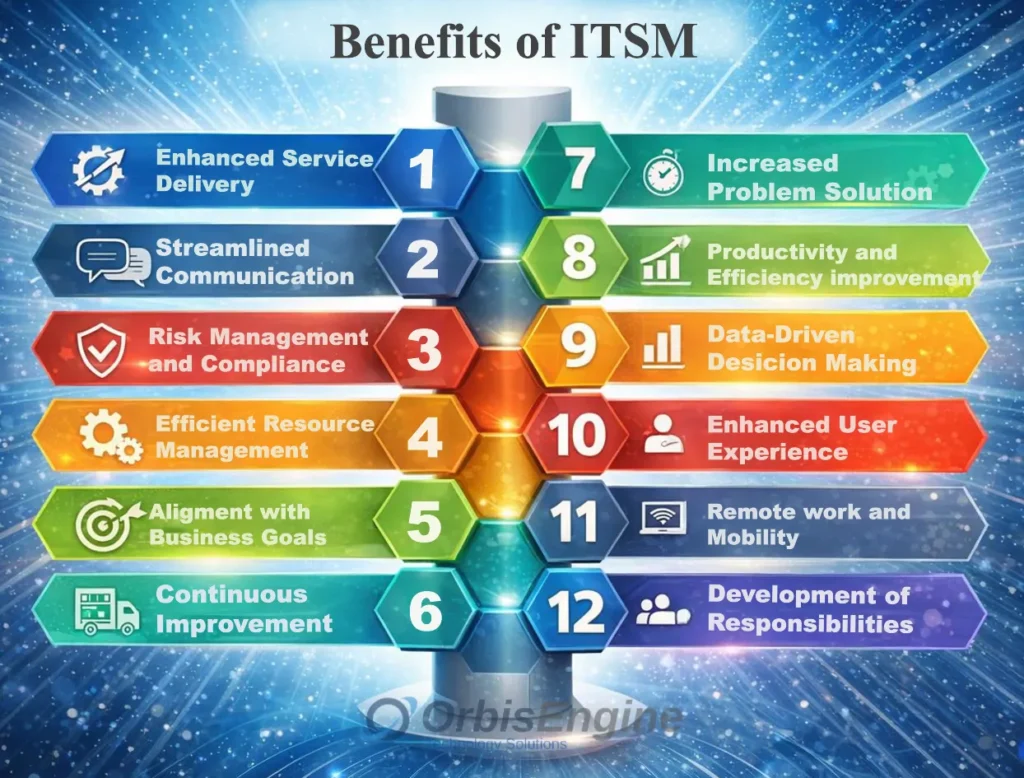
- Improved IT service quality and efficiency
- Cybersecurity and threat management, patch continuity
- Reduced costs and improved resource utilization
- Enhanced business continuity and risk management
- Alignment with industry best practices and standards
Let us help you transform your IT services and drive business success!
Conclusion
ITSM has a significant supportive effect for implementing companies, and its use is projected to increase by an average of 8-10% annually in the coming years. Changes in the decisions of international suppliers have created an opportunity for local developers to benefit from the import substitution trend. As demand continues to grow and investments in the sector increase, all companies in the ITSM solutions field will have the opportunity to enhance their competitiveness and innovation capabilities.
