


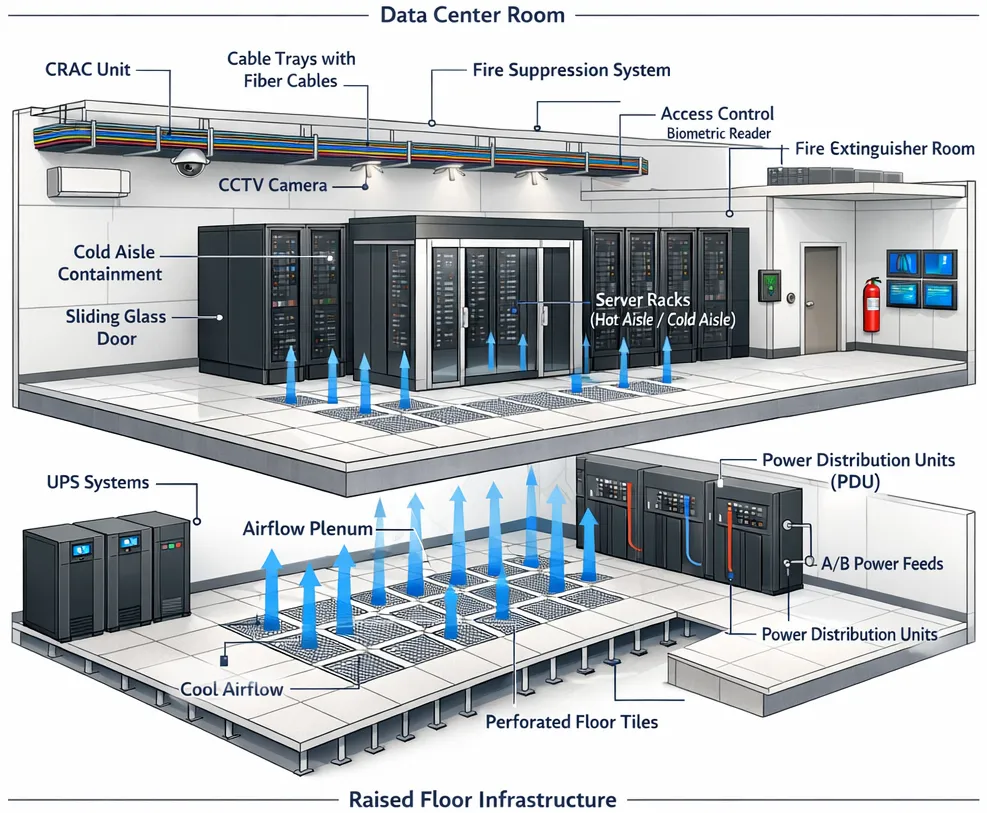
In today’s data-driven economy, organizations depend on resilient, scalable, and secure IT infrastructure. While hyperscale cloud providers like Amazon, Microsoft, Google dominate the market, owning a data center remains a strategic advantage for many enterprises. If your data center is built like an “IT room,” you’ll feel it as downtime, slow incident response, and unpredictable costs. If it’s built like critical infrastructure, you gain control over latency, compliance, and resilience.
“The secret to the solution is to fulfill your data center requirements by adhering to general standards at an optimal level—just your needs, do not overengineer!”
This guide covers data center design fundamentals, common operational mistakes, and maintenance strategies—plus how OrbisEngine Technology can support your infrastructure journey.
Why Owning a Data Center Still Matters
Owning a data center (OwnCloud) is not an ideological choice. It’s a strategic one when you need confidential, self-control, predictable latency, data residency constraints, or physical control of regulated workloads (finance, defense, healthcare, industrial). Hybrid is common: keep “steady-state” and sensitive workloads on-prem, burst/DR to cloud.
Even in the cloud era, on-premise infrastructure offers critical benefits:
- Cost control
Predictable long-term investment vs. variable cloud costs - Full customization & Hardware specialization
Tailored hardware, networking, licensing, and security layers, long term running systems (GPU, HCI, Cluster, low latency storage, custom appliances, custom software, open source low-cost applications) - Data sovereignty & compliance
Organizations must manage information systems to ensure confidentiality, integrity, and availability - Low latency performance
Ideal for real-time applications and mission-critical workloads
From a flexibility perspective, global cloud technology providers (IaaS, PaaS, SaaS) offer advantages, but you must adapt to the existing cloud provider’s standards and bear long-term costs. In real-world applications, costs like licenses and pay-as-you-go don’t always work as described in the documentation! If you’re testing a new project for a short period, global cloud services are very cost-effective (you have no initial investment costs). However, in the long term, product-related costs increase exponentially. For example, using global cloud services for DR purposes or extra backup (hybrid cloud) is currently feasible.
The most crucial positive and logical aspect of OwnCloud is that the security of your own data and applications is always under your control and unaffected by global circumstances. Standards, changes in limitations, sanctions, and revisions in national security decisions and laws in different countries particularly highlight this. A global, universally accepted IT-data standard is still unclear across all countries. Large manufacturing companies have been experiencing the difficulties of this in their investments and product sales to different countries for the last 10 years.
Data Center Design Best Practices
1. Environment Power & Cooling Efficiency
- Use N+1 or 2N redundancy models
- Optimize airflow with hot aisle / cold aisle containment and cold-air grates
- Track PUE (Power Usage Effectiveness) (Per Cabinet and total consumption)
2. Scalable Network Architecture
- Implement leaf-spine topology
- Use SDN (Software-Defined Networking) for flexibility
- Ensure multi-provider redundancy
3. Infrastructure & Platform Choices
- Enterprise-grade hardware (Clustered)
- Virtualization (Hyper-V, VMware, Proxmox, KVM)
- Open-source systems
- Software Defined Network / Storage
4. Security & Compliance
- Physical security controls (biometrics, CCTV, humidity, smoke detectors)
- Network protection (firewalls, UTM, IDS/IPS)
- Standards: ISO/IEC 27001/27002, ENISA, NIST SP 800-53
Common Data Center Mistakes to Avoid
Avoid these frequent (and costly) pitfalls:
- ❌ No scalability planning → leads to early redesign costs
- ❌ Single points of failure → increases downtime risk
- ❌ Lack of monitoring tools → no visibility into system health
- ❌ Poor documentation → slower incident response
- ❌ Human error in configurations → major outage cause
Data Center Maintenance & Support Strategies
A high-performing data center requires continuous optimization.
Preventive Maintenance
- Regular UPS & cooling inspections
- Firmware and OS updates
- Hardware lifecycle tracking
Monitoring & Observability
- Centralized logging
- Real-time metrics
- Capacity forecasting
Incident & Disaster Management
- Defined runbooks
- Regular disaster recovery drills
- Backup and replication strategies (DC-DRC / BC)
As Amazon emphasizes:
“Operational excellence is achieved through continuous monitoring and iterative improvement” Amazon
Where OrbisEngine Technology Fits (Design → Operate → Improve)?
A good data center is a living system. OrbisEngine Technology can support the full lifecycle:
5.1 Assessment & Design Validation
- Site readiness (power, cooling, physical controls), single points of failure
- Architecture review aligned to reliability/operations principles
5.2 Implementation & Standardization
- Rack layout, containment, labeling, and cable discipline
- Baseline hardening and configuration standards for Microsoft/Linux/hypervisors
- Monitoring + alerting integration (NMS/SIEM/ITSM)
5.3 Operations Automation (Reduce Human Error)
- “Infrastructure as Code” style automation using management system
- Patch orchestration, configuration drift control, golden images
5.4 Maintenance Services (Preventive + Corrective)
- Preventive routines (quarterly/annual plans)
- Remote hands coordination, spares strategy
- Change management, incident response playbooks
Conclusion
Owning a data center is still a powerful strategy for organizations needing confidentiality, performance, control, and compliance. However, success depends on:
- Smart design decisions
- Avoiding operational mistakes
- Strong maintenance and monitoring
With the right partner like OrbisEngine Technology, your data center becomes more than just an infrastructure offering strategic IT solutions designed to scale your business; it becomes a competitive advantage.
